
Big Tech and The Built Environment Pt. 1
Eat It: Food delivery, corporate slop, and ghost kitchens.

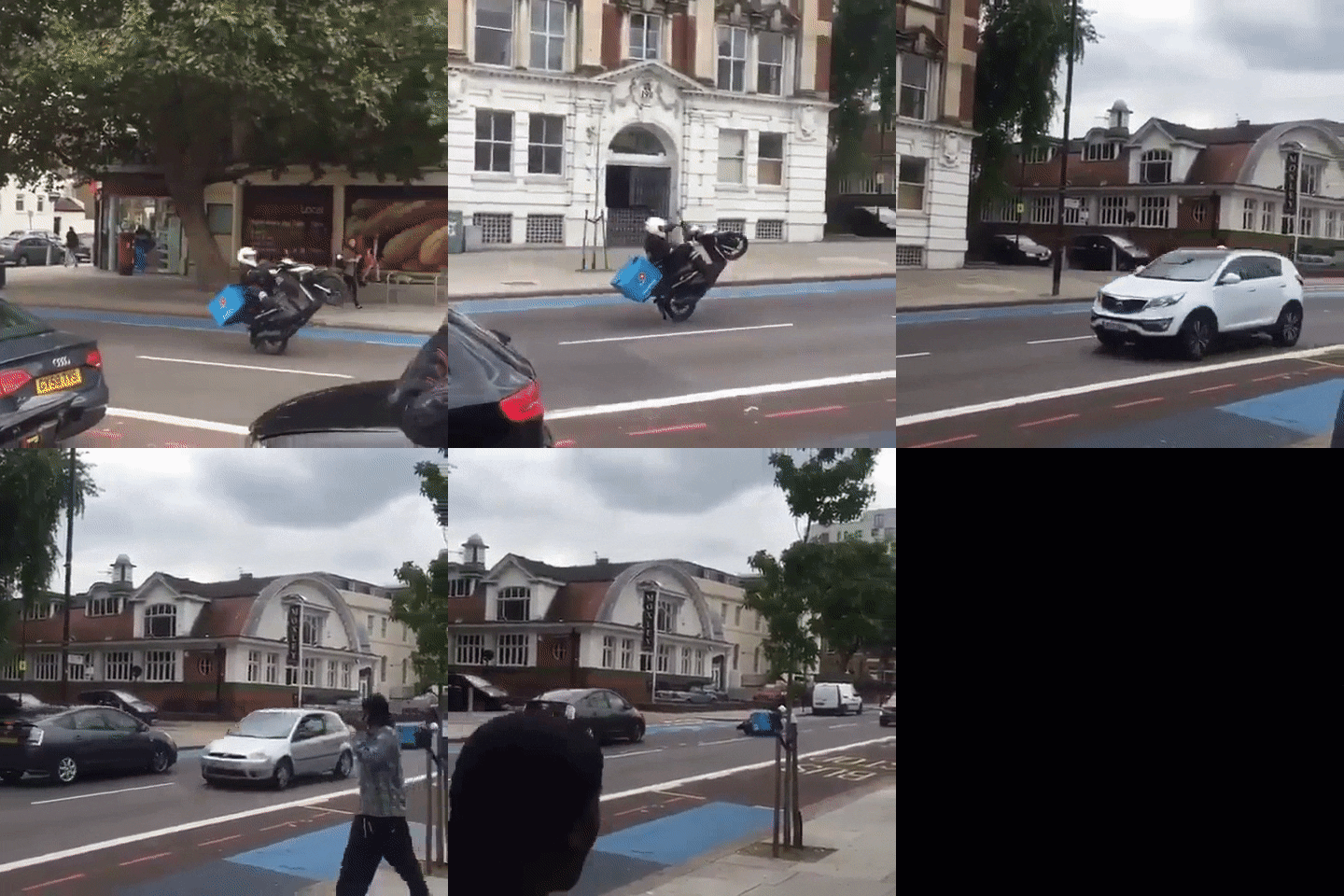
The ‘move fast and break things’ model of big tech (read: move fast and ignore regulation) is wreaking havoc on our built environment. It’s almost as if Robert Moses has reincarnated as a Silicon Valley tech bro, his bloated spirit echoing in the minds of every vest-donned Murray Hill-er grunting ‘innovation at all costs!’ drooling over Airbnb, Uber, GrubHub, and Waymo.
But alas, urban planners, researchers, wonks, and nerds are fighting back. Cassim Shepard is one of them. In his book Citymakers, he lays out the reality perfectly:
“Uber, Facebook, Airbnb, and the like have huge implications for urbanism, but the nature of their disruption is just as often predicated on circumventing regulation as it is on delivering convenience to customers without having to invest capital in a fleet of cars, a catalog of media producers, or the real estate and staffing of traditional hospitality. For these companies, the regulation may be inconvenient. It often serves the needs of professional lobbies in ways that increase costs for consumers or obstruct opportunities for the underemployed to enter heavily regulated parts of the job market. But regulation also ‘expresses a long-established rough consensus about a social contract,’ ignoring a or brute-forcing your way through it makes you look like a major asshole.”
In this series of articles, we’ll explore how these ‘innovations’ sacrifice the health of our people and our cities in the name of ‘convenience’ and ‘innovation’. Starting with what fuels us: food.
In a city obsessed with cuisine, big tech was always bound to intervene. These interventions range from the obvious (food delivery and corporate slop) to the invisible (ghost kitchens, virtual brands, and commissaries). But regardless of how obvious the intervention, the impact is undeniable.
Our Insatiable Hunger for Food Delivery
In Q1 of 2025, New Yorkers spent over $120 million on food delivery from delivery app services alone. While deliveries per hour have nearly doubled since 2022, the number of workers delivering this food has decreased.
Starting July 2023, app-based food delivery workers were guaranteed a minimum wage of $17.96/hr after the Department of Consumer and Worker Protections found they were earning only $7.09, almost half the NYC minimum wage of $15/hr.
The 2023 legislation increased overall average pay for food delivery workers, but the downtick in average tips is what raises red flags for me. While an increase in worker earnings is excellent, the decrease in tips is a damning indicator of how market greed works. Consumers are lowering their tips so they don’t feel the wage increase in their overall spend. This is exactly why we need more regulation.
While legislation and advocacy from groups like Los Delveristos Unidos make major strides, media and press can’t stop talking about the ways these tensions bubble to the surface on our streets: specifically in the form of super-charged zooming e-bikes that some claim are ‘making the city a nightmare.’
From AI Slop to Corporate Slop
In other parts of the city, big tech is showing up in another… flavor… of influence: corporate slop. While the internet churns out AI slop of animals doing backflips and Will Smith eating spaghetti, big tech is churning out fiber-rich slop bowls for corporate folk.
We see its brick-and-mortar roots in what many young professionals now call ‘the salad district’ (FKA FiDi) on what many young professionals now call ‘work island’ (FKA Manhattan), where corporate cogs can get their daily corporate slop.
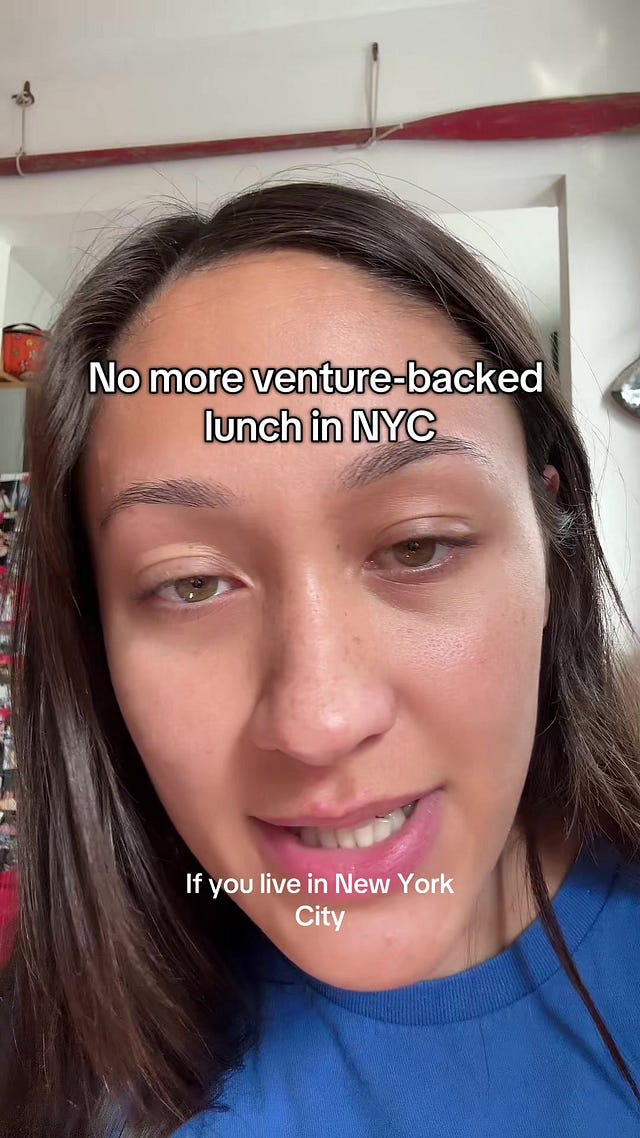
What is corporate slop? Salads! Rice Bowls! Salads! Vaguely ethnic bowls! Vaguely ethnic wraps! And salads!
One TikToker is sick of it, lamenting, ‘I don’t want to see you order a venture-backed lunch…’
 Tiktok failed to load.
Enable 3rd party cookies or use another browser
And these restaurants are…. everywhere.
Ghost Kitchens
Ghost kitchens are the sneakiest types of tech ‘innovation’ impacting our cities and haunting our delivery orders.
But what are ghost kitchens?
‘Ghost kitchens’ are often shorthand for the stock-photo-riddled, pun-laden ‘restaurants’ on GrubHub, but the reality of what makes a ghost kitchen is much more complicated.
Due mainly to the pandemic surge of food delivery, a 2023 CNN article raised flags, reporting, “big investors, celebrity chefs and chains rushed to open ghost kitchens during the pandemic, and they were expected to make up more than 20% of the restaurant industry by 2025.” But not all ‘ghost kitchens’ are built (or permitted) the same, and there doesn’t seem to be a common understanding of the typology.
In their viral 2022 piece, “Why is NYC Kellogg’s Diner Selling Food Under 18 Different Restaurant Names on Delivery Apps?” Eater uncovered one way that these new types of kitchens and brands are showing up. The article revealed Kellogg’s strategy to parse and repackage its food under multiple ‘brands’, allowing it to raise prices and stay afloat during the pandemic.
“...none of the aforementioned [delivery] apps limit how many virtual brands an individual restaurant can operate or how many dishes each brand is required to serve to be listed on their platform, so long as each concept is “unique” and “not a duplicated menu,” according to a spokesperson for Grubhub.”
While the Kellogg’s model is not a ‘ghost kitchen,’ nor is it as potentially predatory as other ghost kitchens, it illustrates how increasingly difficult it has become to find out exactly where and who we are getting our food from when we order online.
I spoke to a manager at one of the largest ‘ghost kitchens’ in NYC. The space they oversee is home to over a dozen kitchens all under one roof. They helped break down how the industry works.
There are a few types of businesses we may call ‘ghost kitchens.’ These typologies have not made their way into the public data or zoning, and are tough to differentiate on a city-wide scale.
Commissary kitchens / shared kitchens are spaces that house operations where individual brands or restaurants can operate, sometimes managed by large-scale operators, also known as orbital kitchens.
Inside these facilities, you can find a range of operators. These can be virtual brands, which are often sub-brands prepared in the same kitchen (imagine one kitchen with five cooks, each preparing pad thai for a brand listed as ‘thai 2 go’ and burgers for a brand called ‘burgers 4 u’).
There are also new small-business restaurants that could be small-business operations using the flexible rental of an orbital kitchen as an opportunity to pressure-test a new concept without fully committing to a brick-and-mortar store.
There may also be established brick-and-mortar restaurants (like mom-and-pop shops) that want to outsource their delivery operations to a commercial kitchen facility.
While certain visual cues (like stock images) and naming conventions (like high gloss stock photos) might clue users in to the likelihood that the restaurants they’re choosing are virtual brands, there’s no way to immediately tell without doing a deep dive.
…and I couldn’t help but WONDER
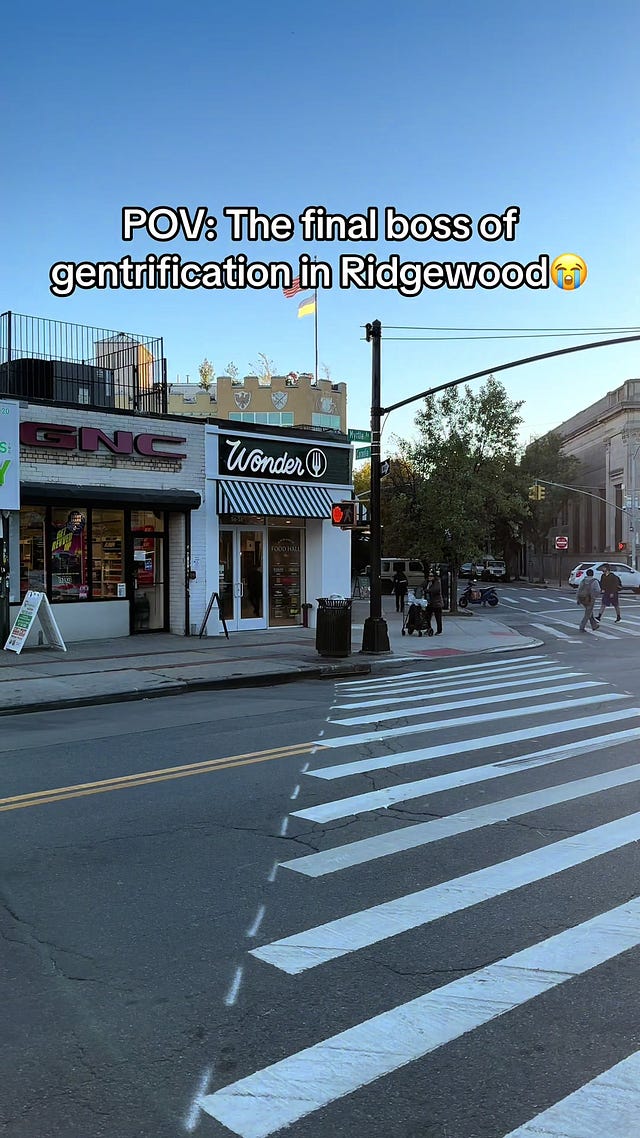
There are also retail-ready food delivery stores like GoPuff and Getir, often referred to as ‘dark stores’, which have been heavily criticized for their effect on the built environment but act more as micro-fulfillment centers than ghost kitchens. But the strangest and most controversial right now is WONDER.
Wonder lives at the center of the hellish Venn diagram of big tech and its effects on our food ecosystem and is perhaps the worst offender of these ‘innovations.’ In my opinion, it is the Frankenstein of all that is unholy in the culinary world.
 Tiktok failed to load.
Enable 3rd party cookies or use another browser
Wonder is a brick-and-mortar venture-backed ‘food hall’ but primarily advertises its food delivery services. While some people speculate that the food is frozen, delivered, and heated up at the store, they are wrong. The answer is… somehow just as bad. The food is primarily prepared in NEW JERSEY and brought to the store locations before being “finished onsite in each physical location, using compact, bare-minimum, ventless kitchens.” The company’s strategic shift is thanks to a former Sweetgreen executive, so maybe Wonder is the new demon spawn of ghost kitchens AND corporate slop.
So, what?
While the issues that bubble to the surface and get the most press coverage (from slop bowls to zooming e-bike delivery workers) may be the most visible symptom, the more nefarious root of the sickness is much more complex.
Like all policy issues, the pain points we see in the press or day to day are simply the symptoms of a larger problem. In the case of our food ecosystem, there are two immediate and relatively low-lift changes I think we can make that will bring clarity to the issue and dig into the root of the cause.
Classify Ghost Kitchens in Public Data
The data was incredibly hard to work with due to the fact that these establishments are currently all categorized as ‘restaurants’ for further research and advocacy to be accurate, the DOHMH should consider creating a definition of ‘ghost kitchen’ and identifying them as such in the data.
Stop Focusing on E-Bikes, Start Focusing on Food Delivery Apps
Changing the speed limit for e-bikes and cracking down on delivery riders themselves will not alleviate the pressure from the apps for delivery drivers to move faster and deliver more. While 2023 legislation was a step in the right direction, policy should continue to explore the ways food delivery apps are incentivising dangerous riding, and media outlets should stop demonizing and further stigmatizing e-bike users.
This is a great entry piece and good idea for a series (and I think Blank Street should have made it into food but I digress). I personally think the landscape for day to day urban technology has lots to improve, which is ironic as most of the money going to these companies are backed by people that don't always understand how cities work. There's so much potential for tech to actually be helpful here, but both sides conflict with timelines, money, and implementation.